Start the conversation today. Fill out the form and take the first step toward measurable growth.
Thank you! Your submission has been received!
Oops! Something went wrong while submitting the form.
Close
Boost Your Local SEO and Strengthen Your Local Visibility: AI-Powered Strategies for Dominating Your Local Market
Local search visibility has become the lifeblood of businesses serving geographic communities, with 46% of all Google searches seeking local information and 76% of people who search for something nearby visiting a business within 24 hours. As artificial intelligence reshapes how search engines understand and deliver local results, businesses must evolve their local SEO strategies to maintain competitive advantage in their markets. This comprehensive guide explores how local businesses can leverage AI-driven local search optimization, optimize Google Business Profile listings, build local authority through strategic marketing, and strengthen your local visibility to attract potential customers actively searching for your products or services. Whether you're a restaurant competing for "near me" searches, a professional service provider building local presence, or a retail store seeking to dominate your local market, understanding the intersection of local SEO and AI proves essential for capturing high-intent local traffic that converts into revenue and long-term customer relationships.
Understanding Local SEO: What Makes Local Search Different from Traditional SEO?
Local SEO represents a specialized branch of search engine optimization focused on improving visibility in local search results when potential customers search for products or services near their geographic location. Unlike traditional SEO targeting broad, national keywords, local search engine optimization prioritizes geographic-specific queries including "near me" searches, city or neighborhood names combined with business categories, and location-based service requests. The fundamental difference lies in intent—local searchers want immediate, nearby solutions rather than general information.
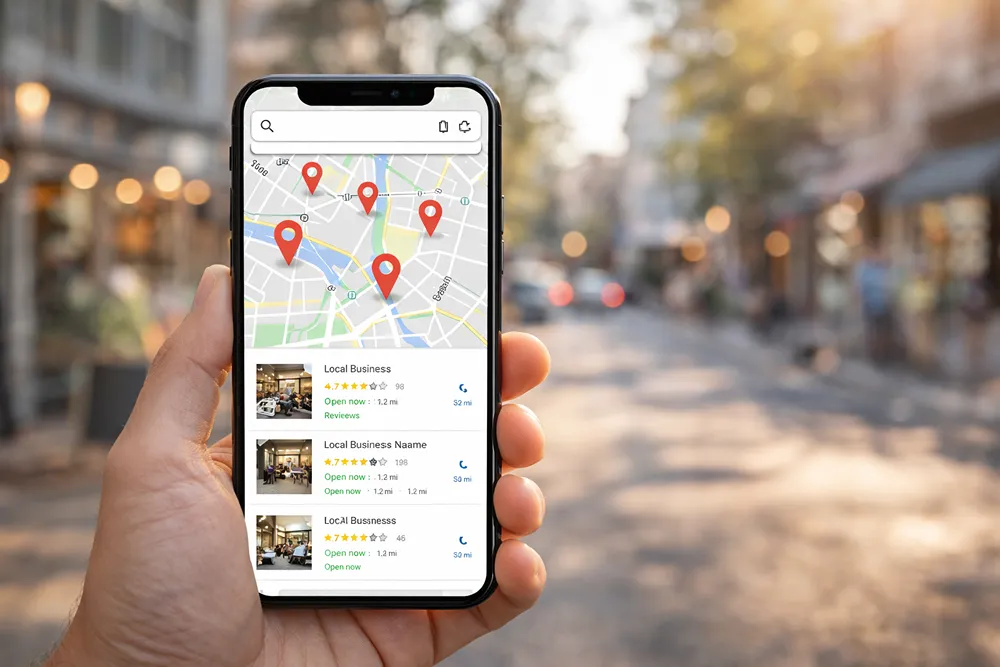
Search engines treat local queries differently than informational searches, triggering specialized result formats designed to connect users with nearby businesses quickly. The local pack results—the map section displaying three businesses prominently at the top of search results—captures the majority of clicks for local queries, making appearance in this coveted space critical for local business success. Google Maps integration further emphasizes local results, with many users bypassing traditional search entirely to find businesses directly through map interfaces.
Local ranking factors differ substantially from traditional SEO signals. While domain authority, content quality, and backlinks remain important, local SEO prioritizes Google Business Profile optimization, customer reviews, local citations (mentions of business name, address, and phone number across directories), proximity to searcher location, and location-specific content. The Google Business Profile Help Center emphasizes that businesses with complete, accurate profiles optimized with photos, posts, and responses to reviews significantly outperform incomplete listings. Understanding these distinctions enables businesses to allocate resources effectively, focusing on local SEO tactics delivering maximum impact for geographic market dominance rather than spreading efforts across less relevant national SEO strategies.
How Is AI Transforming Local Search and What Does It Mean for Local Businesses?
Artificial intelligence has fundamentally transformed how search engines process local queries, understand user intent, and determine which businesses deserve prominent placement in local search results. AI-powered natural language processing enables search engines to interpret conversational queries, recognize synonyms and related concepts, and understand context surrounding location-based searches. When users ask "best Italian restaurant for date night near downtown," AI systems comprehend multiple intent layers—cuisine type, occasion appropriateness, specific neighborhood—delivering results matching these nuanced requirements.
AI search algorithms continuously learn from user behavior, evaluating which local businesses satisfy searcher intent based on engagement signals including click-through rates, time spent on business listings, direction requests, phone calls, and website visits. Machine learning models identify patterns correlating specific business attributes—review sentiment, photo quality, response rates, menu completeness—with user satisfaction, adjusting rankings to prioritize businesses demonstrating these success indicators. This creates dynamic ranking systems where local SEO success depends increasingly on genuine quality and customer satisfaction rather than simply optimizing technical factors.
The convergence of local seo and ai introduces new opportunities and challenges for local businesses. AI-powered features like Google's multisearch allowing users to search using images combined with text, voice search optimization for hands-free local queries while driving, and augmented reality features overlaying business information onto physical environments all represent AI-driven evolution in local search. Businesses that adapt marketing strategies to these AI-enabled search behaviors—optimizing for conversational queries, maintaining high-quality visual content, encouraging and responding to customer reviews—position themselves advantageously as AI continues reshaping the local seo landscape. Research from Search Engine Land indicates that AI-optimized local listings receive 40-60% more engagement than traditionally optimized profiles, demonstrating the competitive importance of AI-aware local search optimization.
What Role Does Google Business Profile Play in Local Search Visibility?
Google Business Profile (formerly Google My Business) functions as the cornerstone of local seo strategy, serving as the primary information source Google uses when displaying businesses in local pack results, Google Maps, and knowledge panels. A complete, optimized Google Business Profile dramatically increases your visibility in local search results, with businesses maintaining active, comprehensive profiles ranking significantly higher than competitors with incomplete or neglected listings.
Profile completeness proves critical for local ranking success. Essential elements include accurate business name, address, and phone number (NAP) matching information on your website and other directories; primary and secondary business categories accurately reflecting your offerings; detailed business description incorporating local keywords naturally; comprehensive attributes (wheelchair accessibility, payment methods, parking availability); high-quality photos showcasing exterior, interior, products, and team; regular posts sharing updates, offers, and local event participation; and consistent hours including special hours for holidays. Each completed element sends signals to Google about your business legitimacy and relevance.
Active management of your Google Business Profile extends beyond initial setup to ongoing optimization and engagement. Responding promptly and professionally to all customer reviews—both positive and negative—signals to search engines that your business values customer feedback and maintains active community engagement. The review response rate and quality influence local search rankings while also affecting consumer trust when evaluating potential businesses. Utilizing Google Posts to share timely updates, special offers, local events, or content relevant to your local audience keeps profiles fresh and engaging. Monitoring Google Search Console to see how users find your listing, which queries trigger your appearance, and what actions they take provides insights for continuous optimization. Regular photo uploads showing seasonal changes, new products, team members, or customer interactions help search engines and users understand your business dynamically. The BrightLocal Local Search Ranking Factors Study identifies Google Business Profile signals as the single most influential factor in local pack rankings, emphasizing the critical importance of profile optimization and management.
How Can Local Businesses Build Local Authority and Trust?
Building local authority represents a long-term investment that compounds over time, establishing your business as the trusted local resource within your community and service category. Local authority signals to search engines that your business deserves prominent placement because community members, other local businesses, and authoritative sources recognize your expertise and value. This authority manifests through multiple channels requiring coordinated effort across digital and physical community engagement.
Local backlinks from reputable community sources carry substantial weight in local seo algorithms. Earning mentions and links from local news outlets covering community events or business features, local chamber of commerce directories and member profiles, community organization websites where you participate or sponsor, educational institutions if you provide relevant expertise or sponsorships, and other complementary local businesses through partnership pages or resource sections all contribute to local authority. The quality and relevance of these local citations matter more than quantity—a single link from a trusted local newspaper or university carries more weight than dozens of low-quality directory listings.
Community involvement builds both digital authority and real-world reputation that feeds back into local search visibility. Sponsoring local events like charity runs, festivals, or youth sports creates brand visibility in local markets while often earning website mentions and local media coverage. Participating in local chamber of commerce activities, networking groups, or business associations provides relationship-building opportunities and typically includes directory listings and event mentions. Contributing expertise through local workshops, speaking engagements, or educational content positions your business as the local specialist in your field. Creating local content on your website and blog—covering local news relevant to your industry, featuring local customer success stories, addressing local challenges or concerns, and providing resources specifically valuable to your local audience—helps search engines understand your local relevance while attracting local traffic.
Partnerships with other local businesses create mutual support systems amplifying authority for all participants. Cross-promotion through shared events, referral arrangements, or content collaboration introduces your business to complementary local audiences. These partnerships often generate the authentic local backlinks and brand mentions that strengthen visibility in local searches far more effectively than purchased links or artificial directory submissions.
What Are the Most Effective Local Keywords and How Should They Be Used?
Local keywords represent the search terms local customers use when seeking your products or services within specific geographic areas. Effective local keyword research balances search volume, competition levels, and commercial intent to identify opportunities where your business can realistically achieve high local search rankings while attracting qualified local traffic likely to convert into customers.
Primary local keywords typically combine your business category with geographic modifiers: "[service] in [city]," "[product] near [neighborhood]," "best [category] [city name]," or simply "[business type] near me." Tools like Google Keyword Planner, SEMrush, and Ahrefs provide search volume and competition data for these terms, though local search volumes often appear lower than national searches despite representing high-value, high-intent traffic. Long-tail local keywords incorporating specific services, product features, or customer needs—"emergency plumber downtown [city]," "vegan-friendly Italian restaurant [neighborhood]," "certified [professional service] [zip code]"—often face less competition while attracting highly qualified searchers further along their purchase journey.
Strategic local keyword implementation requires natural integration across multiple website elements without forced repetition or keyword stuffing. Homepage and service pages should include local keywords in page titles, H1 headings, and opening paragraphs naturally describing what you offer and where. Dedicated location pages for businesses serving multiple areas provide opportunities to target neighborhood-specific keywords while offering customized content addressing each area's unique characteristics and customer needs. Blog content can target informational local keywords like "how to choose [service] in [city]" or "guide to [category] for [city] residents," establishing authority while capturing early-stage search traffic.
Meta titles and descriptions incorporating local keywords improve click-through rates from search results while reinforcing geographic relevance to search engines. Image alt text should include local keywords when describing photos of your location, local team members, or service delivery in specific areas. Internal linking using local keyword anchor text connects related pages while distributing SEO value and helping search engines understand your site's local relevance structure. However, keyword optimization must serve user experience first—content should read naturally and provide genuine value, with keywords enhancing rather than dominating the reading experience. The Moz Beginner's Guide to SEO emphasizes that effective keyword strategy balances optimization with user-focused content that earns engagement, links, and conversions.
How Do Customer Reviews Impact Local SEO and What's the Best Management Strategy?
Customer reviews represent one of the most influential factors in local search rankings, consumer decision-making, and overall local seo success. Search engines interpret review signals—quantity, quality, recency, and diversity across platforms—as indicators of business reputation and trustworthiness. Businesses with substantial positive review profiles consistently outrank competitors with fewer or lower-rated reviews, even when other optimization factors are comparable. Beyond rankings, reviews directly affect conversion rates, with 88% of consumers trusting online reviews as much as personal recommendations.
Review quantity matters significantly, particularly for newer businesses establishing credibility. Encouraging satisfied customers to share experiences helps build review volume that signals legitimacy to both search engines and potential customers. However, review quality—reflected in ratings, review length, keyword relevance, and sentiment—carries equal or greater weight. Detailed reviews mentioning specific services, staff members, or experiences provide richer signals to AI-powered search algorithms analyzing review content to understand business strengths and match them to searcher intent. Recent reviews carry more weight than historical ones, as search engines prioritize current reputation over past performance.
Review management strategy should emphasize authentic accumulation rather than artificial manipulation, as search engines penalize fake reviews, incentivized reviews, or review gating (only requesting reviews from satisfied customers). Effective approaches include requesting reviews from customers after successful service delivery through follow-up emails or text messages, making the review process easy by providing direct links to Google Business Profile or other review platforms, training staff to mention reviews during positive customer interactions, and creating in-store signage or receipts with review request information. Tools like Moz Local or BrightLocal help monitor reviews across multiple platforms from centralized dashboards.
Responding to reviews—both positive and negative—proves equally important as accumulating them. Thoughtful responses to positive reviews expressing gratitude and highlighting specific details customers mentioned demonstrate engagement and encourage others to share experiences. Professional, constructive responses to negative reviews show potential customers that you care about service quality and actively address concerns. Response best practices include acknowledging the customer's experience, apologizing when appropriate, offering to resolve issues offline, and demonstrating commitment to improvement without becoming defensive. The aggregate of reviews and responses creates a reputation profile that influences both algorithmic rankings and human decision-making, making review management an essential component of local seo strategy.
What Technical Local SEO Factors Help Search Engines Understand Your Local Business?
Technical local seo ensures search engines can accurately identify, understand, and display your business information in local search results. While less visible than customer-facing elements like reviews or content, technical factors create the foundation enabling all other local optimization efforts to succeed. Local business schema markup represents perhaps the most important technical element, using structured data to explicitly communicate business information to search engines in machine-readable format.
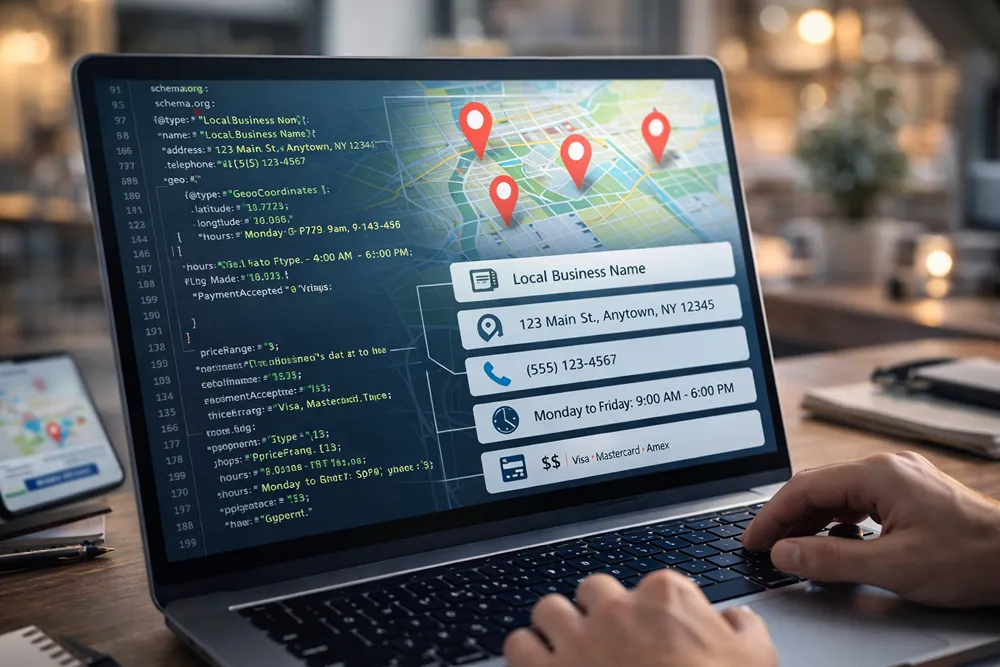
Local business schema markup implemented through Schema.org vocabulary includes business name, address, phone number, geographic coordinates, business hours, accepted payment methods, price range, service area, and other relevant attributes. This structured data helps search engines better understand your business details without relying solely on unstructured content interpretation. Rich schema markup can trigger enhanced search result displays including business details, ratings, hours, and other information directly in search results, improving visibility and click-through rates. Google's Structured Data Testing Tool verifies proper implementation and identifies errors preventing search engines from using your markup effectively.
NAP consistency—ensuring your business name, address, and phone number appear identically across all online mentions—sends strong signals to search engines about business legitimacy and location accuracy. Inconsistencies (different phone numbers, address variations, name discrepancies) confuse search engines and dilute local ranking signals. Regular citation audits using tools like Moz Local, BrightLocal, or Whitespark identify inconsistencies requiring correction across directories, social platforms, and other listings. Embedding Google Maps on your website's contact page provides additional location verification while offering user convenience.
Mobile optimization carries heightened importance for local seo since the majority of local searches occur on mobile devices where users seek immediate nearby solutions. Fast mobile page loads, touch-friendly navigation, click-to-call phone numbers, and mobile-optimized directions features improve user experience while sending positive signals to mobile-first search indexes. Local pages should load quickly, display properly on small screens, and enable friction-free contact or transaction initiation. Regular monitoring through Google Search Console identifies mobile usability issues affecting local search performance and provides specific recommendations for technical improvements.
How Can Voice Search Optimization Improve Local Search Visibility?
Voice search has transformed local search behavior, with voice-activated queries growing rapidly as smart speakers, digital assistants, and hands-free smartphone features become ubiquitous. Voice search queries differ fundamentally from typed searches—they're longer, more conversational, question-based, and heavily location-oriented. Optimizing for voice search requires adapting local seo strategy to match these natural language patterns while ensuring your business information is accessible to voice assistants.
Voice search optimization begins with targeting conversational local keywords and question-based phrases matching how people speak rather than type. Instead of optimizing for "plumber Boston," voice-optimized content targets "who is the best plumber near me" or "where can I find an emergency plumber open now in Boston." Creating FAQ pages addressing common customer questions using natural language helps capture voice queries while providing valuable information to both voice and traditional searchers. Content should answer the who, what, where, when, why, and how questions relevant to your local business and services.
Claiming and optimizing your business information across major voice platforms—Google Assistant, Apple Siri, Amazon Alexa—ensures accurate information delivery when users ask voice assistants about your business or category. These platforms primarily pull data from Google Business Profile, Apple Maps, Bing Places, and other major directories, making consistent, complete listings across these sources essential for voice search success. Featured snippet optimization targeting position zero in search results improves voice search visibility since voice assistants often read featured snippet content as answers to user queries.
Local context optimization helps voice assistants understand your relevance for location-based voice queries. This includes clear location information on every page, localized content addressing neighborhood or city-specific needs, and mobile-friendly experiences since most voice searches occur on mobile devices or smart speakers connecting to mobile data. As voice search continues growing—particularly for local queries like directions, hours, and near-me searches—businesses optimizing for conversational, question-based queries position themselves advantageously for this increasingly important traffic source. Research from Search Engine Journal indicates that 58% of consumers use voice search to find local business information, making voice search optimization an essential component of comprehensive local seo strategy.
What Advanced Local SEO Strategies Separate Leaders from Competitors?
Advanced local seo strategies build on foundational optimization to create differentiated competitive advantages in increasingly crowded local markets. Hyperlocal content creation targeting specific neighborhoods, districts, or micro-markets within larger cities enables businesses to dominate ultra-specific local queries that competitors ignore. Creating dedicated pages or blog content for each neighborhood you serve—discussing local landmarks, addressing area-specific concerns, featuring local customers or projects—signals deep community integration to both search engines and local audience members seeking businesses that truly understand their specific locale.
Multi-location SEO for businesses with multiple physical locations requires sophisticated approaches balancing brand consistency with location-specific optimization. Each location should have dedicated website pages with unique content (not duplicated across locations), individual Google Business Profiles properly verified and optimized, location-specific reviews and photos, and local landing pages targeting that area's keywords and community. Multi-location businesses should implement location finders helping users identify the nearest branch, localized phone numbers or contact methods for each location, and tracking systems measuring performance by location to identify optimization opportunities.
Event-based local seo leverages participation in or sponsorship of local events to boost visibility and authority. Creating website content about local events you attend, sponsor, or host generates timely local content while often earning mentions and links from event websites, local news coverage, and participant posts. Live-updating content during community events, posting photos and recaps afterward, and continuing conversation through social media extends event value beyond single-day participation. Sponsoring local events creates lasting brand visibility in local markets while generating the authentic local mentions and backlinks that strengthen search engine authority signals.
Competitive local seo analysis identifies gaps between your optimization and top-ranking competitors, revealing opportunities for differentiation. Tools like BrightLocal, Whitespark, or SEMrush provide competitive analysis features comparing your local presence against competitors across metrics including review volume and ratings, citation consistency, content volume and quality, local backlink profiles, and Google Business Profile completeness. Identifying where competitors excel highlights areas requiring improvement, while finding their weaknesses reveals opportunities to capture market share through superior optimization in neglected areas.
How Can Local Businesses Measure and Track Local SEO Performance?
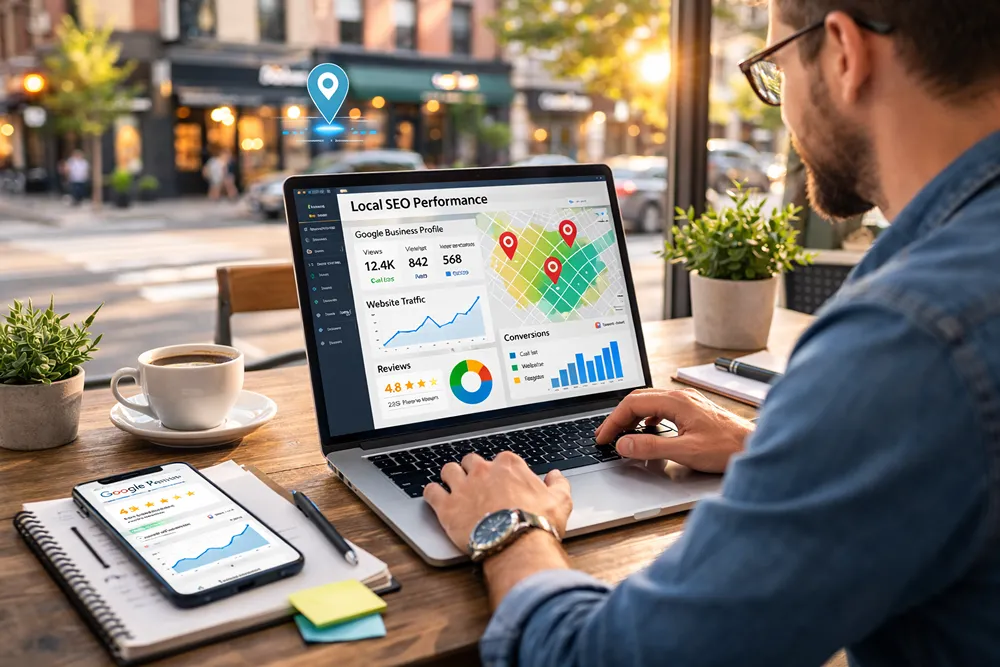
Measuring local seo success requires tracking multiple metrics across different stages of the customer journey and understanding how local visibility translates into business outcomes. Google Business Profile Insights provides fundamental data about how users find and interact with your listing, including search queries triggering your appearance, whether users found you through direct searches (searching your business name) versus discovery searches (searching your category or service), actions taken including website visits, direction requests, and phone calls, and photo views comparing your image engagement against competitors.
Local search ranking tracking monitors your position in local pack results and organic search for target local keywords. Tools like BrightLocal, Whitespark, or Local Falcon provide location-specific rank tracking showing where you appear for searches from different neighborhoods or ZIP codes within your service area—critical since local rankings vary significantly based on searcher proximity to your business. Grid-based local rank tracking visualizes your visibility across geographic areas, identifying strong coverage zones and areas requiring focused optimization.
Website analytics through Google Analytics or similar platforms track traffic from local searches, visitor behavior, and conversion completion. Setting up goal tracking for local-specific actions—contact form submissions from local pages, phone calls from click-to-call buttons, direction requests, location finder usage—demonstrates how local visibility drives business outcomes. UTM parameters on links from your Google Business Profile and local directory listings enable attribution tracking showing which local platforms generate the most valuable traffic.
Review metrics including total review count across platforms, average rating, review velocity (reviews per month), response rate and time, and sentiment analysis of review content provide insights into reputation management effectiveness. Citation consistency scores from tools like Moz Local or BrightLocal track NAP accuracy across directories, identifying discrepancies requiring correction. Competitive benchmarking comparing your metrics against top competitors reveals whether you're gaining or losing market share and where focused efforts might yield greatest returns. The Google Analytics Help Center provides detailed guidance on setting up local tracking and attribution modeling to accurately measure local seo impact on business growth.
Frequently Asked Questions About Local SEO and Local Search Visibility
How long does local SEO take to show results? Local SEO typically produces faster results than national SEO, with improvements often visible within 2-3 months for optimized Google Business Profiles and 4-6 months for comprehensive local search strategies. However, building sustainable local authority through reviews, citations, and backlinks requires ongoing effort over 6-12 months for competitive markets.
Is it better to focus on Google Business Profile or website SEO for local visibility? Both prove essential and reinforce each other. Google Business Profile optimization delivers faster results for local pack appearance and map searches, while website optimization captures organic search traffic and provides content supporting overall local authority. Comprehensive local seo strategy requires optimizing both channels simultaneously.
How many reviews do I need to rank well in local search? Review quantity matters less than relative volume compared to competitors. In less competitive markets, 10-20 reviews might suffice for strong rankings, while competitive urban markets may require 50-100+ reviews. Focus on steady review accumulation (2-4 monthly) rather than single review bursts, as consistency signals ongoing customer satisfaction.
Should I create separate pages for each neighborhood or city I serve? Yes, for areas representing significant business volume and where you can create genuinely unique, valuable content for each location. Avoid thin, duplicated location pages that simply swap city names—search engines penalize low-quality doorway pages. Each location page should offer substantial unique content addressing that area's specific characteristics and customer needs.
Can I do local SEO if my business is entirely online or service-based without a physical location? Absolutely. Service area businesses can optimize for local search by specifying service areas in Google Business Profile, creating location-specific content targeting served areas, building local citations in relevant directories, earning local backlinks from served communities, and optimizing for local service queries even without physical storefronts.
Key Takeaways: Mastering Local SEO for Sustainable Local Market Dominance
Local SEO differs fundamentally from traditional search engine optimization by prioritizing geographic-specific ranking factors including Google Business Profile optimization, customer reviews, local citations, proximity to searcher, and location-specific content targeting near-me and city-based searches
AI transformation of local search enables search engines to understand conversational queries, evaluate business quality through engagement signals, and dynamically adjust rankings based on user satisfaction, making genuine quality and customer experience increasingly important for local seo success
Google Business Profile serves as the cornerstone of local search visibility, with complete, actively managed profiles featuring accurate information, comprehensive attributes, high-quality photos, regular posts, and prompt review responses dramatically outperforming incomplete or neglected listings
Building local authority requires coordinated efforts earning local backlinks from community sources, participating in local events, partnering with complementary businesses, and creating local content that establishes your business as the trusted local specialist in your field
Local keywords combining business categories with geographic modifiers should be naturally integrated across website elements including page titles, headings, content, meta descriptions, and image alt text while prioritizing user experience over keyword density
Customer reviews represent one of the most influential local ranking factors, with review quantity, quality, recency, and management strategy affecting both search engine algorithms and consumer decision-making, making authentic review accumulation and professional response practices essential
Technical local SEO including local business schema markup, NAP consistency across citations, mobile optimization, and embedded maps helps search engines accurately identify and display your business information in local search results and map interfaces
Voice search optimization targeting conversational, question-based queries and ensuring accurate business information across voice platforms captures the growing segment of voice-activated local searches occurring on mobile devices and smart speakers
Advanced strategies including hyperlocal content for specific neighborhoods, multi-location optimization, event-based SEO, and competitive analysis separate market leaders from competitors in increasingly competitive local markets requiring sophisticated differentiation
Performance measurement tracking Google Business Profile insights, local ranking positions, website traffic from local searches, review metrics, and citation consistency provides data-driven insights for continuous optimization and demonstrating local seo roi
Local search visibility represents a critical competitive advantage for businesses serving geographic markets, with the majority of local searches resulting in store visits, phone calls, or purchases within 24 hours. By understanding how AI is reshaping local search, optimizing Google Business Profile comprehensively, building authentic local authority through community engagement, managing customer reviews strategically, and implementing technical optimizations that help search engines understand your local relevance, businesses can dominate local search results and attract the high-intent local traffic that drives sustainable growth. Success in local seo requires consistent effort across multiple channels, patience as authority builds over time, and adaptation as search engines continue evolving their local algorithms. However, businesses that invest in comprehensive local search optimization position themselves advantageously to capture market share from competitors while building the digital presence and community reputation that supports long-term local market leadership.





.svg)