Start the conversation today. Fill out the form and take the first step toward measurable growth.
Thank you! Your submission has been received!
Oops! Something went wrong while submitting the form.
Close
SEO Copywriting: How to Create Content That Ranks High and Converts Every Reader
Most businesses treat SEO and copywriting as two separate jobs — one for getting found, the other for making sales. But the most successful content online does both at the same time. SEO copywriting is the practice of writing content that ranks high in search engine results pages while simultaneously persuading readers to take action. It's the intersection of visibility and conversion — and mastering it is one of the highest-leverage skills in all of digital marketing.
This guide breaks down everything you need to know about SEO copywriting — from keyword research and search intent to CTAs, pain points, and conversion optimization. Whether you're writing content for a service page, a blog post, or a landing page, this article will give you a proven framework for creating copy that connects and converts. If you want your content to do more than just exist on the internet — read on.
1. What Is SEO Copywriting and Why Does It Matter?
SEO copywriting is the practice of writing content that is strategically optimized for search engines while being genuinely compelling and persuasive for human readers. Think of SEO copywriting as the bridge between visibility and action — it's how you get found by the right people and then convert them into customers once they arrive. Copy bridges the gap between organic traffic and business results.
The challenge is that copy isn't just well-written — it's strategically structured to satisfy both the algorithm and the audience. Great copy speaks to your target audience's needs, addresses their pain points, and naturally incorporates the keywords that search engines use to determine relevance and ranking. When these elements align, the result is content that ranks and revenue that follows.
Copy isn't a luxury for businesses that want to grow online — it's a necessity. According to HubSpot's Marketing Statistics, businesses that prioritize content marketing generate significantly more leads than those that don't. SEO copywriting amplifies this advantage by ensuring that high-quality content doesn't just sit on your website — it actively works to attract, engage, and convert potential customers every single day.
2. How Do You Align SEO Content With Search Intent to Drive Conversions?
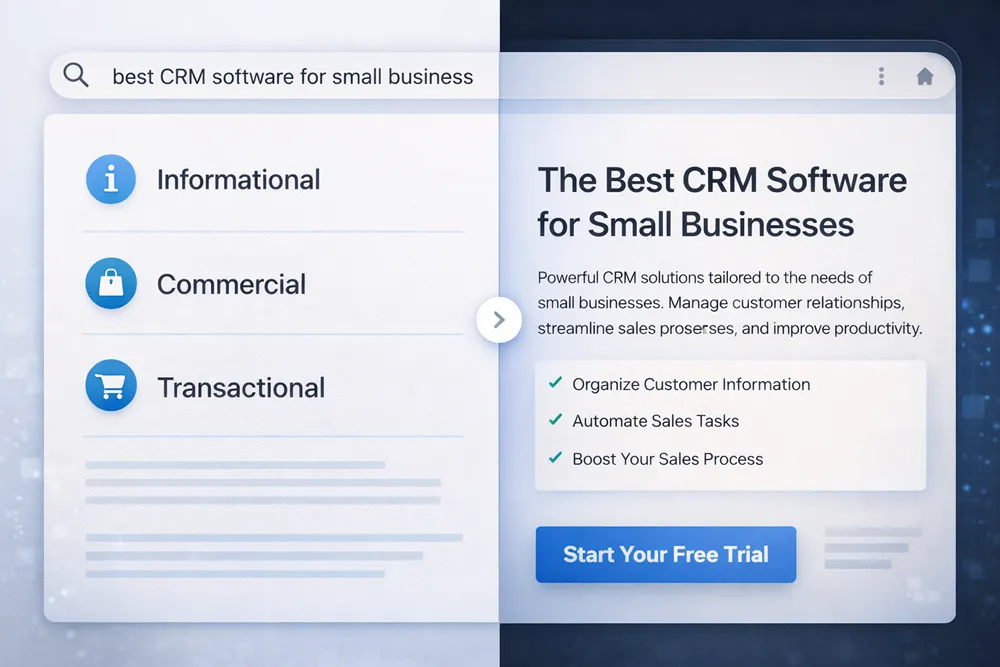
One of the most important principles in SEO copywriting is aligning your content with search intent — the underlying reason someone types a query into a search engine. Search intent falls into four main categories: informational, navigational, commercial, and transactional. Content that is optimized for the wrong intent will rank poorly and convert even worse, because it doesn't match what the user actually came looking for.
When you're writing content for a service page, the search intent is almost always commercial or transactional — meaning the visitor is close to making a decision and needs to be persuaded. In this case, your SEO copy should lead with the value of your product or service, address objections early, and include strong CTAs that guide the reader toward conversion. Content that's informational in tone on a transactional page loses potential customers at the critical moment.
Understanding search intent is what separates good SEO content from high-converting copy. Moz's Keyword Explorer is one of the best tools available for analyzing keyword intent at scale — helping you create content that ranks for the right queries and resonates with readers who are ready to act. Aligning every piece of content with its intended search intent is the foundation of any effective SEO content strategy.
3. What Role Does Keyword Research Play in Creating Copy That Converts?
Keyword research is the compass of SEO copywriting — it tells you what your target audience is actually searching for, in their own words. Without it, you're writing content in the dark, hoping it connects with the right people. With it, you can craft copy around the exact phrases and questions your ideal customers are using to find businesses like yours.
Effective keyword research goes beyond finding terms with high search volumes. The best SEO copywriters look for keyword opportunities that combine reasonable search volume with clear commercial intent and manageable competition. Long-tail keywords — more specific, lower-volume phrases — often convert at higher rates because they attract users who are further along in the buying journey and know exactly what they're looking for.
Once you have your keyword data, the goal is to integrate those terms naturally into your content — in headlines, subheaders, body copy, meta descriptions, and image alt text — without forcing them in ways that disrupt readability. Ahrefs' Keyword Research Guide offers a comprehensive walkthrough of how to conduct keyword research that feeds directly into high-converting copy. Keyword research isn't just an SEO task — it's the foundation of content that ranks and sells simultaneously.
4. How Do You Write Persuasive Copy That Speaks to Your Audience's Pain Points?
The most persuasive content isn't about your business — it's about your reader. Specifically, it's about the pain points they're experiencing and the transformation your product or service offers. When you write copy that names the problem your audience is living with before presenting your solution, you create an immediate emotional connection that drives conversion far more effectively than feature-heavy descriptions.
Pain points are the emotional and practical challenges your target audience faces every day. A roofing company's audience isn't just looking for shingles — they're worried about water damage, rising repair costs, and protecting their family's home. A copywriter who understands this writes content that resonates with those fears first, then presents the service as the relief. This emotional-first approach is what separates high-converting copy from generic web copy that fails to move readers.
Med Spas and wellness clinics are a perfect example of businesses that benefit from pain-point-driven SEO copywriting. Their potential customers are often self-conscious, time-pressured, and skeptical after bad experiences elsewhere. Copy that acknowledges these feelings — and then clearly explains how the service solves them — builds trust, drives bookings, and produces higher conversion rates than copy focused solely on treatment descriptions.
5. What Makes a Call to Action Work — and How Do Strong CTAs Boost Your Conversion Rate?
A call to action is the moment your content stops informing and starts converting. CTAs direct readers toward the next step — whether that's scheduling a consultation, requesting a quote, signing up for a free trial, or calling your office. Without a clear and compelling CTA, even the most well-written content fails to drive conversions because it leaves the reader without a direction.
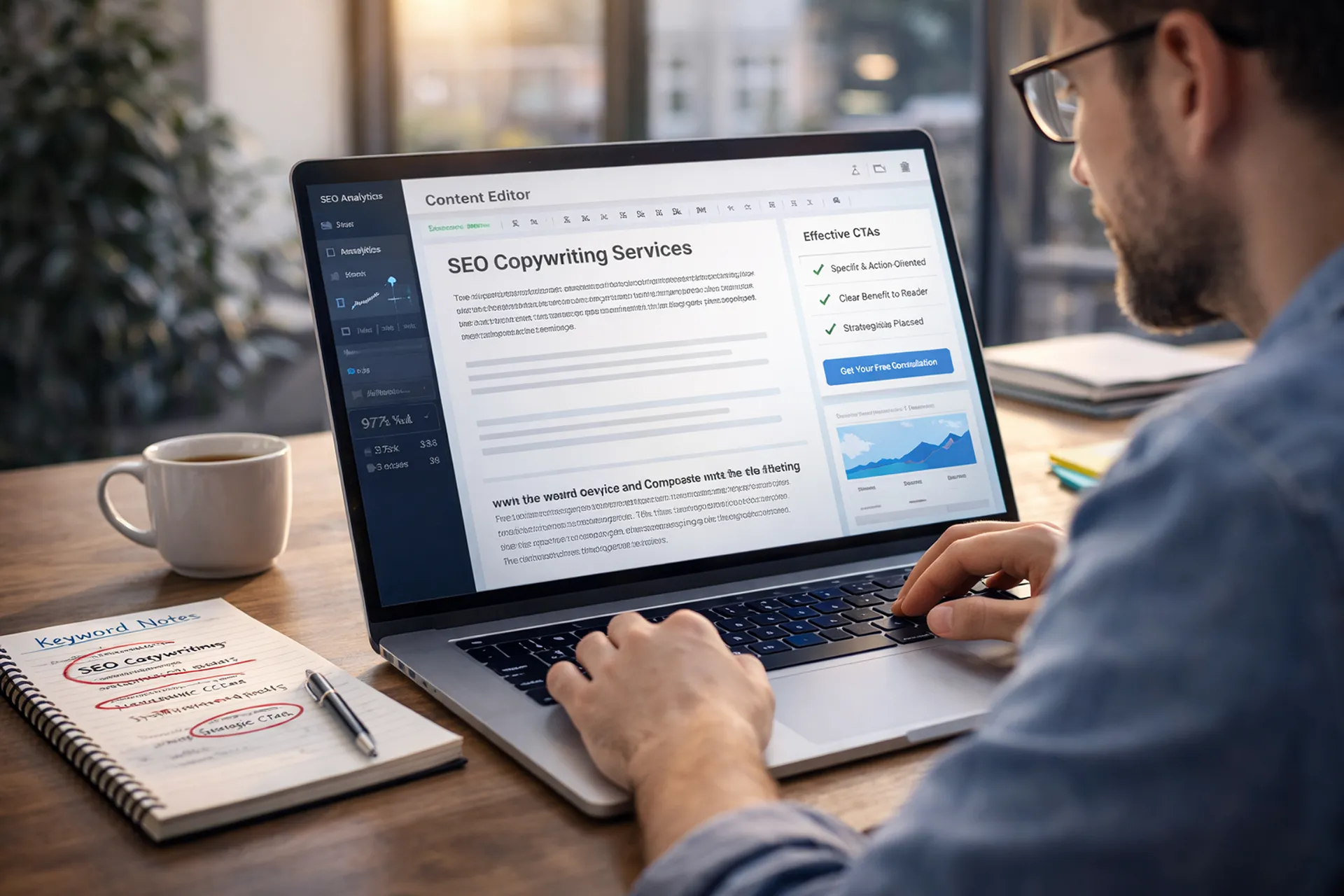
Effective CTAs are specific, action-oriented, and tied to the value the reader will receive. "Get My Free Consultation" outperforms "Contact Us" because it names the benefit, not just the action. CTAs should appear multiple times throughout long-form content — at the top, in the middle after key value points, and at the bottom — because different readers convert at different stages of engagement. Placing CTAs strategically can significantly boost your conversion rates without changing a single word of body copy.
Your CTA language should align with the temperature of your audience. Readers landing on a blog post for the first time need a softer CTA — like downloading a guide or reading a related article. Readers on a service page are warmer and ready for a direct offer. VisioneerIT's Pay Per Click Management services are built around exactly this principle — matching the right message and CTA to the right audience at the right stage of the funnel to maximize conversion from every click.
6. How Do You Optimize Your Copy for Both Search Engines and Human Readers?
The most common mistake in SEO copywriting is over-optimizing for search engines at the expense of the reader — or the opposite, writing beautifully for humans while ignoring SEO entirely. Optimized copy achieves both goals simultaneously by using keyword-rich language that flows naturally, answers real questions, and maintains a tone that resonates with the audience.
To optimize your copy effectively, structure matters as much as substance. Use your primary keyword in the H1 title, naturally within the first 100 words of body content, in at least one H2 subheader, and throughout the body copy at a density that feels organic rather than forced. Short paragraphs, clear subheaders, and bullet points improve readability — which reduces bounce rate and signals to search engines that users are engaging positively with your content.
According to Search Engine Journal's Copywriting Guide, the pages that consistently rank highest in search results are those that fully satisfy user intent while demonstrating clear expertise and authority on the topic. Make your copy informative enough to rank, persuasive enough to convert, and readable enough that visitors stay long enough to do both. This is the standard that every piece of content we produce should meet.
7. What Are the Best Practices for Writing SEO-Friendly Content for Service Pages?
Service pages are often the highest-converting pages on a business website — and yet they're frequently the most neglected from an SEO copywriting standpoint. Many businesses write service pages that are little more than a list of features, missing the keyword optimization, search intent alignment, and persuasive structure needed to both rank and convert effectively.
Best practices for SEO-friendly content on service pages include: leading with a benefit-driven headline that includes your primary keyword, writing a compelling opening paragraph that speaks to the target audience's needs, using subheaders that incorporate secondary keywords and answer common questions, and closing every section with a micro-CTA that nudges the reader toward conversion. Each service page should be treated as its own landing page — built to rank for a specific query and convert visitors who arrive from that query.
Accountants and advisory firms often struggle with service page copy that's too technical and jargon-heavy to resonate with prospective clients. The best approach is to write content that translates complex services into clear, client-focused benefits — using the language their audience searches with, not the language the industry uses internally. This approach improves both search rankings and conversion rates at the same time.
8. How Does Blog Content Fit Into an SEO Content Strategy That Converts?
Blog content is the cornerstone of most SEO content strategies — and when done right, it creates a consistent pipeline of organic traffic that feeds higher-converting service and landing pages. The key is to write content that ranks high for informational queries while using strategic internal linking and CTAs to guide readers toward conversion opportunities deeper in the site.
Every blog post should be written with a dual purpose: to rank in search engine results for a target keyword and to move the reader one step closer to becoming a customer. This means every blog post needs a clear next step — whether that's reading a related article, downloading a resource, or clicking through to a relevant service page. Copy doesn't work in isolation; it works as part of a connected content ecosystem.
VisioneerIT's Search Engine Optimization services incorporate this blog-to-conversion content architecture — ensuring that every piece of blog content is optimized for search, aligned with the buyer journey, and connected to the service pages most relevant to what the reader came looking for. This is how quality content turns organic traffic into qualified leads on a consistent basis.
9. What Is the Connection Between SEO Copywriting and Social Media Marketing?
SEO copywriting and social media marketing are more interconnected than most marketers realize. The same understanding of your target audience, their pain points, and their language that makes for great SEO copy also makes for compelling social media content. Businesses that develop strong content strategies tend to see their social media performance improve as a byproduct — because they've done the audience research that fuels both channels.
Social media also amplifies SEO content by driving traffic, generating brand searches, and earning backlinks from people who discover and share your content. Short-form copy used in social posts — ad copy, captions, and video scripts — draws directly from the same keyword and audience insights that guide your long-form SEO content strategy. The best marketers treat SEO and social as part of a unified content ecosystem, not separate silos.
Social Media Marketing from VisioneerIT is built with this integration in mind — creating brand messaging that resonates across platforms while reinforcing the SEO content strategy that drives organic visibility. When your social content and SEO copy speak the same language, your brand becomes more recognizable, more trusted, and more likely to convert across every touchpoint.
10. How Do You Refine and Improve Your SEO Copywriting Over Time?
The best SEO copywriters understand that great copy is never truly finished — it's refined over time based on data. Tracking key performance indicators like organic traffic, time on page, bounce rate, and conversion rate for every major piece of content gives you the feedback loop needed to improve continuously. Content that's not converting at the level you'd expect is a signal to revisit the copy, not just the SEO.
A/B testing headlines, CTAs, and opening paragraphs is one of the most effective ways to refine high-performing copy and boost your conversion rate without creating new content from scratch. Small changes — like rewriting a headline to better match search intent, or repositioning a CTA earlier in the page — can produce significant lifts in both engagement and conversion. Every data point is an opportunity to learn what resonates and what doesn't.
According to Neil Patel's Content Marketing Blog, the businesses that achieve the highest conversion rates from content are those that treat copywriting as a living, iterative discipline rather than a one-time task. Learn SEO copywriting as both an art and a science — and commit to refining your approach with every campaign, every update, and every new piece of content you publish.
Key Takeaways to Remember
SEO copywriting combines search engine optimization with persuasive writing to create content that both ranks and converts — neither goal should be sacrificed for the other.
Search intent alignment is foundational — copy that doesn't match why someone searched won't rank well or convert effectively.
Keyword research is the starting point for all great SEO copy — use it to understand your audience's language, not just their search behavior.
Pain points drive conversion — write copy that names your audience's problems before presenting your product or service as the solution.
CTAs must be specific and value-driven — place them strategically throughout your content to capture readers at every stage of engagement.
Optimize your copy for both humans and search engines — readability, structure, and keyword placement must all work together.
Service pages should be treated as landing pages — each one should rank for a specific query and be built to convert visitors who arrive from it.
Blog content is most powerful when it's connected to your service pages through strategic internal linking and clear CTAs.
SEO copy and social media share the same audience intelligence — integrate your content strategies across both channels for maximum impact.
Refine consistently — use traffic, engagement, and conversion data to continuously improve your copy and drive higher conversion rates over time.





.svg)